
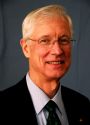
Norm Veliquette’s Year as Rotary 6290 District Governor, 1993-94
Norm Veliquette was the host DGE at the 1993 five-district Great Lakes P.E.T.S. in Grand Rapids. Five years had elapsed since Rotary began admitting women. Among 6290’s 56 presidents-elect, eight were women. Each of Norm’s P-E’s carried a big stick distributed at an early-morning work-out and health breakfast. The sticks were thick oak and maple, personally crafted by the DGE and personalized in their end-grain with a serial number unique to the P-E’s club.
Besides symbolic of authority and strength, the big sticks identified the host class of presidents-elect, who carried them proudly. Back home in their weekly meetings, some had club members “sign on” like fraternity paddles. Some used them as walking sticks after their exhausting year as president. Most treasured their sticks and years later said they always knew exactly where the big stick was. It was never just their stick. It was always their big stick. DGE Norm made the preposterous assertion to the 53 presidents-elect in attendance that he would walk on his hands at his district conference in Traverse City if the district goal of $46/member were achieved in Rotary Foundation annual giving.
The 6290 Directory that year was the first showing a picture of each club president. Veliquette had arranged in advance for a photographer to take pictures at PETS, a practice continued and adopted by other districts. Veliquette held his District Assembly in two sections, an innovation, one at The Shack, hosted by White Cloud for the south half of the district, and one hosted at White Birch Lodge by Elk Rapids for the north. Attendance doubled over previous years. Rotarians in White Cloud, a club that had been on the “watch list” for several years, were inspired at hosting a district event. They inducted 11 new members at the DG’s official visit, growing from 22 to 33, a 50% membership gain.
Veliquette was the first D-6290 governor in more than a decade from a club of less than 40 members, and one of very few DGs the district had who was not retired from his career. He packed his 1993 cherry crop before beginning club visits in mid-August. Visits were marked by courtesy, decorum, and an inevitable presentation of horseradish and other sauces in a gift pack from Chatterlee Farms in Lowell, a delightful and affectionate prank effectively organized without email by Wendell Christoff, one of the DG’s wife’s childhood flames.
First Lady Marjory Veliquette distinguished herself by publishing a cookbook called 600 Very Cherry Recipes, and a booklet called So your Rotary Partner is going to be Club President. Norm and Marjory’s daughter Sara Marie reigned as Miss Elk Rapids. M. Peter McPherson, a brother of First Lady Marjory, began an11-year tenure as president of Michigan State University.
The Life Leadership Conference, after 45 years at Camp Emory on Big Blue Lake near Holton, Michigan, lost its home and faced the demise of its founder Dr. William “Bill” Austin. District 6360, partner in the conference since its founding, withdrew its support and participation. Some considered the conference doomed. A determined district governor formed a committee and with a staff led by Dr. Howard Oesterling and John Noling picked Twin Lakes Conference Center near Traverse City as a new venue.
T.C. Rotarians led by Jack Burns promised support as the host club for a minimum of five years. Then gave six. Dr. Oesterling nursed the Life Leadership Conference through several difficult years in Traverse City. Veliquette stayed on as district chair. After moving to Kettunen Center south of Cadillac in 2000, the event finally caught a new wind with support from DG Betsy Demaray, the leadership of director Charles Bell (a former Rotary Scholar in theater) and LLC committee member Ross Conran from Cooperville. Ella Weymon demonstrated in Holland that it is readily possible to recruit larger numbers of conferees. Rtn. Weymon served six distinguished years as conference treasurer.
Don and Kay Bohls and other Cheboygan Rotarians made a valiant but unsuccessful attempt to extend a Rotary Club in St. Ignace. Community surveys were undertaken in Allendale and Newaygo for Rotary Clubs. Nothing developed. However, December 9, 1993 marked the chartering of Grand Rapids Sunrise, 57th club in the district, the district’s first morning club—the culmination of work by Rtn. Ron Windemuller and previous DGs. By a monumental coincidence, signing of the club’s charter occurred in Evanston the afternoon before DG Veliquette’s official visit. When the club met with the DG the next morning, it was literally the new club’s first sunrise. The Rotary Club of Traverse City organized a Rotaract Club at Northwestern Michigan College, with Rtn. Chet Janik being the moving force.
Dr. Paul Haight and other Rotarians in Spring Lake created a model in World Community Service with their pioneering of the Trelawny Outreach Project in Falmouth, Jamaica. Petoskey Rotary was recognized on the cover of the September 1993 Rotarian for its World Community Service project in Lima, Peru. PDG George Trowbridge’s daughter reviewed for the November Rotarian, the popular book, The Rotary Club Murder Mystery by Graham Lundrum.
D-6290 RYE student June Barnard from Bellaire carried the American flag at the opening ceremonies for the RI Presidential Peace Forum in Johannesburg, South Africa. Barnard witnessed historic talks between F.W. DeKlerk and Nelson Mandela that eventually ended apartheid in South Africa. Yes, a Rotary Youth Exchange student from 6290 was there! Having 29 outbounds and 33 inbound RYEs, Dwight Huskey led 6290 to new heights of success in Rotary Youth Exchange. Clubs recruited a then new record 37 outbound students for the following year. Petoskey rebound RYE student Leah Neiderstadt was named one of 17 women worldwide to receive a Rhodes Scholarship.
D-6290 hit a high-water mark in Ambassadorial Scholars, having four overseas at one time: Kristin Bergers, Rotary’s first scholar in the former Soviet Union, at Moscow State University; Lisa Burchfield in Barcelona; Errol Buxton, Edinburgh; and Jennifer Tank, Canterbury, New Zealand. All corresponded with DG Norm and were featured in his special edition of the district newsletter in February 1994, a bonus edition for Rotary’s World Understanding Month, highlighting Group Study Exchange, Ambassadorial Scholars, and Rotary Youth Exchange.
November 7, 1993, Bea Souter of Shelby became the first 100-year old woman Rotarian. For many years she had regularly attended Shelby’s Rotary meetings and played piano for the club. Sault Ste. Marie, Ontario celebrated the 105th birthday of their long-time member James Gibson. Senior active was then a type of Rotary membership, with Souter and Gibson giving the term a very literal meaning.
Under PDG George Trowbridge’s continued leadership, 6290’s Group Study Exchange occurred with District 1210 in England. The home team consisted of leader Ron Danielson, Traverse City; Ross Marowitz, Sault Ste Marie, Ontario; Kary Scheiern and Janice Wheelock of Greenville; and Wendy Jo Wigger of Holland. The visiting team consisted of leader Barrie Davis, R.C. Shrewsbury; Sara Shillabeer, Annette Kratz; Corah Dempsey; and Andrew Goldsmith.
Dr. Bill Sprague of Grand Rapids, member of the U.S. Immunization Task Force, reported that activities were on schedule to eradicate polio in China, Philippines, Papua New Guinea, Vietnam, Laos and Cambodia by July 1, 1996. Little known in 1994 was that a young polio victim named Luis Fermin in a slum of Lima, Peru was to be the last case of polio in the Western Hemisphere. Due to his paralysis Fermin was abandoned by his parents. Rescued by an orphanage, Fermin visited Traverse City and decade later. Behind the efforts of PDGs Ross Childs, John McElduff, John Morrison, and Norm Veliquette, D-6290 financed a year of Fermin’s high school education.
The Cherry Blossom District Conference of 1994 was hosted in Traverse City by the Rotary Club of Elk Rapids. It featured celebrations of the year’s accomplishments, sailing tours on the Madeline, Winery tours on Old Mission Peninsula, the planting of a commemorative weeping cherry tree at the Park Place Hotel, a fly-over by the US Coast Guard and a spontaneous drive-by by the TC Fire Department. The whole contingent of 70 RYE students visited from their weekend conference at Twin Lakes. Inbound and outbound Rotary scholars and GSE teams made presentations. An intense and contentious three-year process began at the District Conference of upgrading the district’s Manual of Procedure.
The closing session of Veliquette’s conference featured a presentation by aged Bellaire Rotarian Robert Innes. Innes told how he, as a boy in Chicago in the early 1900’s, had a paper route. Among those to whom he delivered papers was Sylvester Scheile, one of the attendees at the formative Rotary meeting called by Paul Harris in 1905. Innes recounted that he later worked for Schiele, and for his work in Schiele’s coal yard his family was paid in coal.
Although the district’s multi-year decline in Annual Giving to The Rotary Foundation was reversed, the per capita goal was not reached. The DG had nonetheless prepared adequately for the possibility that it would be, and for a group of major donors he delivered his first public hand-walk, a short, shaky pass under the chandelier in the lobby of the Park Place Hotel. Veliquette eventually dedicated his hand-walking publicly to Rotary’s campaign to eradicate polio, becoming well known among Rotarians for his publicity stunts, fund-raising, and his three published and widely circulated books on Rotarian NID Volunteers.
Bob Barth of Switzerland led Rotary as RI president. His theme, said to be the wordiest in 100 years, was “Believe in what you do. Do what you believe in.” The DG’s presentations were said to resemble Barth’s theme, long. Email had not yet come, but one club president claimed that his fax machine required a water-cooler to prevent it from being smoked by material from DG Norm. Citing the outstanding events for the Rotary district in his emotional farewell, DG Veliquette conceded that a great year was built on the efforts of local Rotarians and on previous district leaders. He would not know if he had succeeded until he saw what happened in the district in succeeding years.
He was pleased. Inspired and following DG Norm’s example, other young working Rotarians from smaller clubs became district governors; Foundation giving continued to grow; district conferences moved about, with host clubs as far flung as Wawa giving them creativity and interest. District committees conducted flourishing programs, and a general spirit of collegiality and continuity characterized the transition of leadership from year to year. Five club presidents who served under Norm's DG leadership ultimately became district governors.
PDG Norm and his wife Marjory met in college as candidates for an international exchange, then went respectively to Brazil and Nepal. They were passionate about Rotary Youth Exchange. Their expectation was that their future district service would be on the RYE Committee. But the Life Leadership Conference that Veliquette rescued as district governor in 1994 turned out to be his “adopted child” for the next 17 years. In 1995, his daughter Judith was named Conferee of the Year. She took an interest in her father’s work and became for several years a popular and dedicated young staffer and speaker. Several Rotarians recruited to serve as Life Leadership chairs became presidents of their respective clubs and some notably became district governors.
The late PDG Bob Brummeler of Petoskey and his wife Judy and family were loyal workers at the Life Leadership Conference. Naturally, a Rotary friendship developed with PDG Norm. After Norm lost Marjory and Judy lost Bob, Norm and Judy found each other, are making up or making out at Rotary meetings across the country, and by all accounts “living happily ever after.”